





Teams working in cross-border e-commerce, overseas market research, or advertising often face a common question: Which type of proxy IP should they choose?
There are many types of proxy IPs available. Dynamic residential proxies, long-lasting ISP proxies, and datacenter proxies differ in terms of IP source, stability, rotation frequency, and typical use cases. Choosing the right proxy type can help businesses plan their network resources according to their specific requirements.
This article explains the main differences between dynamic residential proxies and long-lasting ISP proxies from the perspectives of IP source, rotation method, connection stability, and business applications. It also uses 9HTTP products as examples to help users select a suitable proxy solution based on their specific needs.
1. About 9HTTP
9HTTP is a proxy IP service provider offering two primary product lines: dynamic residential proxies and long-lasting ISP proxies. Each product is designed for different network access requirements.
Both product lines are managed through the same account system and dashboard, allowing users to select and manage IP resources according to different business scenarios while simplifying proxy configuration and resource management.
The following sections explain the characteristics of dynamic residential proxies and long-lasting ISP proxies across different business scenarios.
2. What Are Dynamic Residential Proxies?
Dynamic residential proxies use IPs from residential network environments and are assigned through Internet Service Providers to residential network users. Dynamic residential proxies can automatically change exit IPs based on configured rules, providing access to a large pool of residential IP resources across different regions.
"Dynamic" mainly refers to the ability to rotate IPs based on requests, time intervals, or sessions. Compared with fixed IP solutions, dynamic residential proxies are more suitable for business scenarios that require flexible IP resources or access from different geographic network environments.
These proxies are commonly used for large-scale data collection, market research, advertising landing page verification, price analysis, and multi-region website testing.
The size of the IP pool and geographic coverage are also important factors when evaluating dynamic residential proxies. Broader coverage provides users with more options for regional network environments.
9HTTP's dynamic residential proxies cover residential IP resources across 200+ countries and regions and support location selection by country and city, making it easier for teams to conduct data analysis and network testing for different markets.
However, because dynamic residential proxies change IPs according to configured settings, they may not be suitable for every business that requires a fixed network endpoint. If a business needs to maintain the same IP over an extended period, a long-lasting ISP proxy may be a better option.
3. What Are Long-Lasting ISP Proxies?
Long-lasting ISP proxies also use IP resources from Internet Service Provider networks, but the IP can remain relatively stable during the agreed service period without frequent rotation like dynamic residential proxies.
This type of proxy combines residential network resources with stable connections and is suitable for business scenarios that require a consistent exit IP over an extended period.
The key advantage of long-lasting ISP proxies is stability. The same IP can be used continuously for a longer period, making this type of proxy suitable for long-term network connections, ongoing business access, overseas website testing, and enterprise applications that require a stable regional network environment.
9HTTP's long-lasting ISP proxies support fixed exit IP configurations based on the selected service period, allowing users to choose IP resources and locations according to their business requirements.
4. Key Differences Between the Two
IP rotation frequency: Dynamic residential proxies can rotate IPs based on requests or time intervals, while long-lasting ISP proxies remain relatively stable during the agreed service period.
Usage duration: Dynamic residential proxies are more suitable for short-term, batch, or periodic network tasks, while long-lasting ISP proxies are designed for long-term and stable network connections.
Network characteristics: Both can use residential or ISP network resources. The primary difference lies in IP usage duration and connection methods.
Typical applications: Dynamic residential proxies are commonly used for data collection, market research, price analysis, and regional testing. Long-lasting ISP proxies are more suitable for long-term network connections, overseas business access, and continuous testing.
Geographic coverage: Dynamic residential proxies generally provide larger IP pools with more location options, while long-lasting ISP proxies place greater emphasis on stable connections from specific locations.
5. Choosing Based on Specific Business Scenarios
1. Cross-Border E-Commerce Market Research
Cross-border e-commerce teams may need to research product information, pricing changes, search results, and website presentations across different countries and regions.
If multiple markets need to be analyzed simultaneously, dynamic residential proxies can provide access to more locations and IP resources, making them suitable for large-scale market research.
If a business needs to access a specific website from a fixed location or conduct ongoing market monitoring, a long-lasting ISP proxy may be a better option.
2. Overseas Advertising Testing
Overseas advertising operations often require testing advertising creatives, landing pages, and page presentations across different regions.
Dynamic residential proxies can provide network access environments from multiple countries and regions, making them suitable for multi-region advertising creative and landing page testing.
If a specific regional advertising page needs to be verified continuously, a long-lasting ISP proxy can provide a more stable network endpoint.
3. Overseas Website and Product Testing
When launching products overseas or conducting localization testing, businesses may need to access websites or applications from different countries and regions.
Dynamic residential proxies are suitable for testing multiple regions, while long-lasting ISP proxies are better suited to ongoing testing from a specific geographic location.
4. Multi-Region Network Environment Analysis
For teams analyzing network environments across different regions, geographic IP coverage is an important consideration.
Dynamic residential proxies can generally provide a wider range of country and city-level IP resources, making them suitable for large-scale regional testing.
Long-lasting ISP proxies are more suitable for testing tasks that require a stable network endpoint in a specific region over an extended period.
5. Data Collection and Price Analysis
Public information data collection and price analysis often require a large pool of IP resources and flexible IP rotation.
Dynamic residential proxies can provide residential IP resources across different regions based on task requirements, making them suitable for public web information analysis, product price research, and market data collection.
If a data collection task requires a stable network endpoint over an extended period, a long-lasting ISP proxy can be selected based on the specific requirements.
6. How to Choose
If the core requirement is "flexible IP resources across multiple regions," dynamic residential proxies are generally a suitable choice.
If the core requirement is "a stable fixed IP for long-term use," long-lasting ISP proxies are generally a better option.
You can also consider the following factors:
Does the IP need to change frequently? If so, consider dynamic residential proxies.
Does the business need to maintain a fixed IP over an extended period? If so, consider long-lasting ISP proxies.
Does the business require IP resources from multiple countries and cities? If so, pay attention to the geographic coverage of dynamic residential proxies.
Is long-term connection stability the primary concern? If so, consider long-lasting ISP proxies.
If a business involves both data collection and long-term network testing, different proxy types can be selected for different tasks.
9HTTP provides dynamic residential proxies and long-lasting ISP proxies for different requirements, from short-term data collection to long-term network connections. Both product lines can be managed through a unified dashboard, allowing users to select the appropriate proxy solution based on IP stability, rotation frequency, geographic coverage, and business requirements.
Before choosing a proxy type, it is recommended to clarify the actual requirements for IP stability, rotation frequency, geographic coverage, and connection protocols, and then select the appropriate product based on the specific use case rather than comparing prices alone.
七、Limited-Time Offer: Save on Your Order
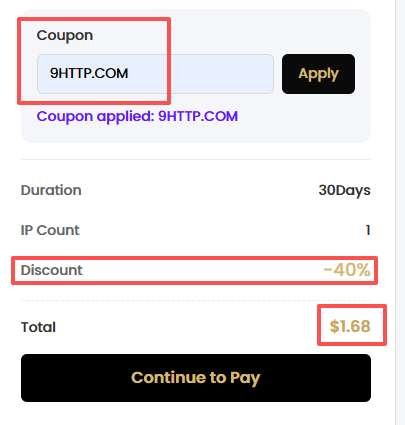
9HTTP is currently offering limited-time discounts on both product lines: 40% off long-lasting ISP proxies and 30% off dynamic residential proxies.
Enter the promo code 9HTTP.COM at checkout to receive the applicable discount.
The final promotional price is subject to the pricing and checkout information displayed on the 9HTTP website.
If you are not sure which proxy type is suitable for your business, you can contact online support to learn more about product configurations and trial options before selecting a proxy service.
Compliance Statement: 9HTTP proxy IP services are intended for market research, public information analysis, data collection, advertising testing, product testing, and other lawful business applications. Users should comply with applicable laws and regulations, as well as the terms of use of relevant websites, platforms, and services, and ensure that their data sources and business activities comply with applicable requirements.