






When using proxy IPs, one common question is: why do some tasks require a different IP for every request, while others work better with the same IP throughout a session? The answer lies in Sticky Sessions.
For tasks that require maintaining login status, simulating real user behavior, or completing a sequence of actions, Sticky Sessions provide a more consistent proxy connection. In this article, we'll explain what a Sticky Session is, how it works, and when it's the right choice for your business.
What Is a Sticky Session?
A Sticky Session is a proxy connection mode that keeps the same proxy IP assigned to your requests for a specified period of time instead of changing it with every request.
For example, if you configure a 30-minute Sticky Session:
- All requests during that session use the same proxy IP.
- Websites typically recognize those requests as coming from the same visitor.
- Once the session expires, a new proxy IP can be assigned according to your configuration.
The alternative is a Rotating Session, where the proxy IP changes automatically with every request. This approach is better suited for scenarios that require frequent IP rotation.
Key Features of Sticky Sessions
Helps Maintain Session Consistency
Many websites identify visitors using a combination of IP address, cookies, and session information. If the IP changes repeatedly during a session, additional verification or interruptions may occur.
By keeping the same proxy IP for a defined period, Sticky Sessions help provide a more consistent network environment for continuous browsing.
Better for Continuous Browsing
Real users typically don't switch IP addresses every few seconds while browsing a website.
For tasks such as navigating multiple pages, filling out forms, or completing multi-step workflows, Sticky Sessions more closely resemble normal browsing behavior.
Suitable for Session-Based Tasks
When a workflow requires multiple related actions within the same session, using a fixed proxy IP helps maintain a consistent connection throughout the process.
When Should You Use a Sticky Session?
Sticky Sessions aren't the right solution for every use case, but they are well suited for scenarios that require session continuity.
1. Social Media Management
Managing social media accounts often involves remaining logged in while performing multiple actions. A Sticky Session helps maintain a consistent network environment during those operations.
2. Cross-Border E-commerce Management
Sellers working on e-commerce platforms usually spend time managing products, processing orders, and updating inventory.
Using the same proxy IP throughout these tasks better supports continuous access to the platform.
3. Website Automation
Automation workflows such as logging in, submitting forms, or retrieving information often require multiple consecutive requests. Sticky Sessions provide a consistent proxy environment throughout the workflow.
4. Overseas Market Research
Researchers frequently browse websites within a specific country or region for extended periods.
A Sticky Session keeps the same proxy IP during the session, making it easier to perform continuous research and collect public information.
Sticky Session vs. Rotating Session
| Sticky Session | Rotating Session |
|---|---|
| Uses the same IP throughout the session | Changes the IP with every request |
| Ideal for session continuity | Ideal for frequent IP rotation |
| Commonly used for account management and dashboard access | Commonly used for public web data collection and price monitoring |
| Provides a consistent browsing environment | Offers greater IP diversity |
In general, if your workflow requires maintaining the same browsing session, a Sticky Session is usually the better choice. If your application benefits from changing IPs frequently, a Rotating Session is more suitable.
How to Choose a Sticky Session Proxy
When selecting a Sticky Session proxy service, consider the following factors:
- Availability of IPs across multiple countries and regions
- Flexible session duration options
- Stable network connectivity
- Support for APIs and standard proxy protocols
- Easy configuration and management
Choosing a solution that matches your business requirements can improve the overall user experience.
Sticky Session Proxies from 9HTTP
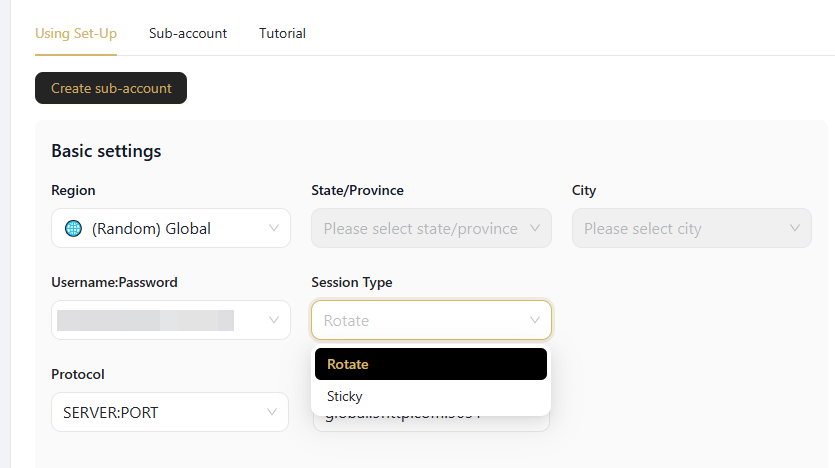
9HTTP provides residential proxy services with support for Sticky Sessions, allowing users to configure session durations based on different business needs.
With residential IP resources covering multiple countries and regions, 9HTTP can be used for cross-border e-commerce, overseas market research, automation testing, public web data collection, and other business scenarios. Users can choose the proxy configuration that best fits their specific requirements.
Conclusion
A Sticky Session is a commonly used proxy connection mode that keeps the same proxy IP for a defined period. It is well suited for applications that require session persistence, continuous browsing, or a consistent network environment.
In practice, the right proxy mode depends on your use case. If maintaining the same session is important, a Sticky Session is often the preferred option. If frequent IP rotation is required, a Rotating Session may be more appropriate.
Interested in trying Sticky Session proxies? 9HTTP offers 500 MB of free trial traffic, allowing you to test residential proxies in your own business scenarios and choose the solution that best meets your needs.