





When businesses use proxy IP services, they need to consider not only IP resources, connection methods, and application scenarios, but also access control management.
A Proxy IP Whitelist is a common access control method that helps businesses manage proxy access sources and make proxy usage more organized.
What Is a Proxy IP Whitelist?
A Proxy IP Whitelist refers to a list of IP addresses that are pre-approved to access a proxy service.
Simply put, only IP addresses added to the whitelist can connect to the proxy service. IP addresses that are not included in the whitelist cannot use the proxy resources, even if they have valid account credentials.
For example, when a company's internal servers, office networks, or fixed outbound IP addresses need to connect to a proxy service, the corresponding IP addresses can be added to the whitelist to manage access from specific network environments.
Why Do Businesses Need a Proxy IP Whitelist?
1. Manage Proxy Access Permissions
Businesses often use proxy IPs for scenarios such as market research, data analysis, and network testing.
Through whitelist management, companies can control proxy access sources and make proxy resource management clearer.
2. Simplify Team Access Management
For businesses with multiple employees, teams, or systems, managing proxy access permissions is important.
By setting allowed IP address ranges, companies can configure access permissions based on different business requirements and make proxy usage more organized across teams.
3. Support Fixed Network Environments
Some businesses conduct operations through fixed office networks, servers, or cloud environments.
In these cases, a Proxy IP Whitelist can associate proxy access with specific network environments, making ongoing management and maintenance easier.
4. Simplify Proxy Integration
When businesses integrate proxies with automation tools, data analysis systems, or internal applications, they often need a stable access method.
By configuring a whitelist, companies can reduce repeated authentication steps and make proxy integration smoother.
What Is the Difference Between IP Whitelist Authentication and Username/Password Authentication?
Proxy services commonly use two authentication methods: IP whitelist authentication and username/password authentication.
IP Whitelist Authentication:
Access is verified based on the connecting IP address.
Features:
- Suitable for fixed network environments;
- Easier access management;
- Commonly used for servers and enterprise networks.
Username/Password Authentication:
Access is verified through account credentials.
Features:
- Suitable for environments with changing network conditions;
- More flexible for different users or teams;
- Convenient for distributed access scenarios.
Businesses can choose the appropriate authentication method based on their network environment and operational needs.
9HTTP Proxy IP Whitelist Management Feature
When businesses use proxy IP services, flexible access control methods can help improve proxy resource management.
9HTTP supports Proxy IP Whitelist management, allowing businesses to add specified IP addresses to a whitelist based on their network requirements and manage proxy access sources.
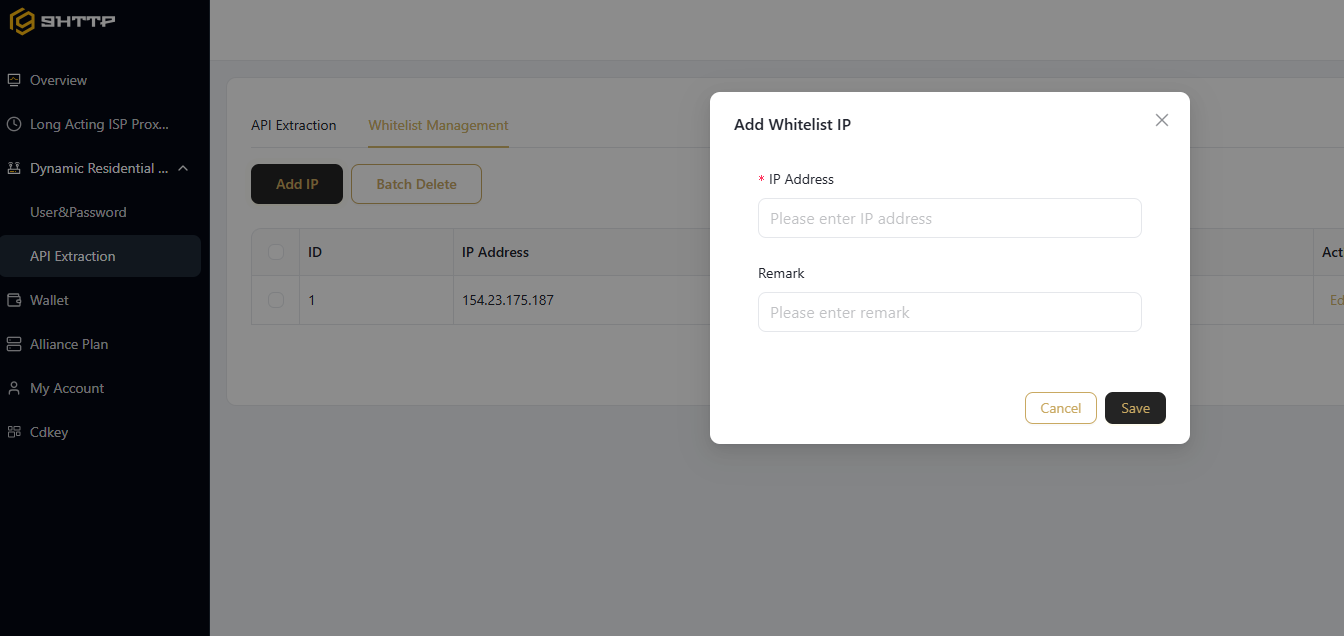
With 9HTTP, businesses can configure proxy IP resources according to different application scenarios. The service supports multiple proxy types and protocols and can be used for compliant scenarios such as market research, public data analysis, SEO analysis, and network testing.
What Should Businesses Consider When Configuring Proxy IPs?
When configuring proxy IP services, businesses should consider the following:
- Choose an authentication method based on actual business requirements;
- Regularly review proxy access permissions;
- Follow target platform policies and applicable laws and regulations;
- Use proxy services only for legal and compliant business purposes.
Conclusion
A Proxy IP Whitelist is a common way for businesses to manage proxy access permissions. It can help standardize proxy usage processes and improve access management efficiency.
As global business operations continue to grow, proxy IPs are increasingly used in scenarios such as market research, data analysis, and network testing. Combined with access control methods like IP whitelisting, businesses can build network environments that better match their operational needs.
Disclaimer: Proxy IP is a network technology tool and should only be used for legal and compliant business scenarios while following applicable laws, regulations, and platform policies.