


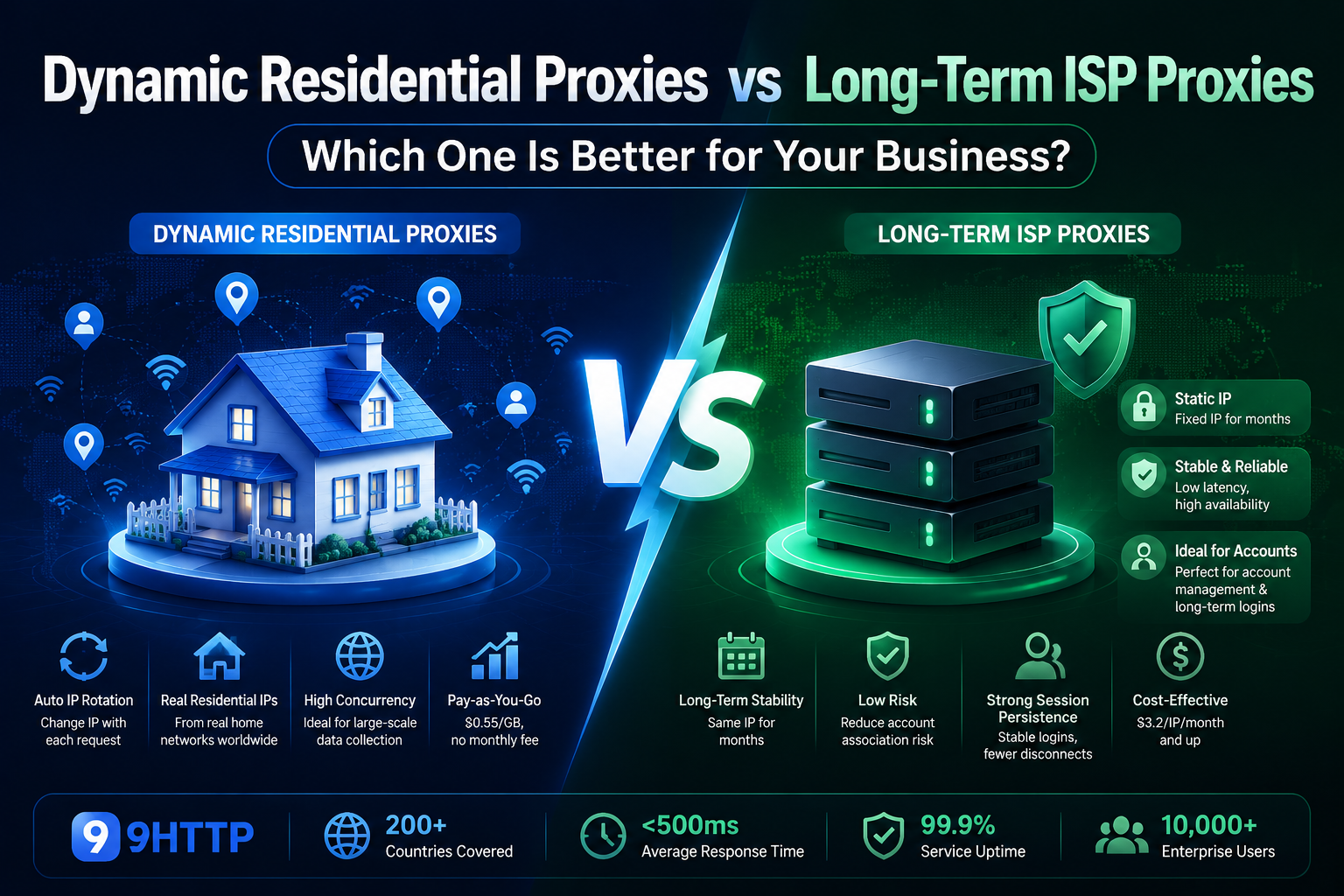



If you work in cross-border e-commerce, social media marketing, or data collection, you are likely familiar with proxy IPs.
As a proxy provider covering 200+ countries and regions with a residential IP pool of 80M+, 9HTTP serves proxy requests from businesses across a wide range of industries. One of the most common decisions businesses face is choosing between dynamic residential proxies and long-lasting ISP proxies.
This guide compares the two proxy types based on their technical characteristics and common business applications, helping you determine which option better fits your needs.
1. What Are Dynamic Residential Proxies?
Dynamic residential proxies use IP addresses associated with real residential networks and automatically rotate IPs based on requests or a configured rotation interval.
Key Features
Automatic IP rotation — IP addresses can change based on the configured session or rotation settings, making them suitable for tasks that require access from different network endpoints.
Residential IP networks — IPs are sourced from residential network environments, providing access that is representative of residential internet connections.
Usage-based billing — Pricing is typically based on traffic usage, making it suitable for projects where proxy consumption varies.
Country and region targeting — Supports IP targeting across 200+ countries and regions for location-based research and testing.
Typical Applications
| Scenario | Why Dynamic Residential Proxies Fit |
|---|---|
| Web data collection | Flexible IP rotation supports high-volume data workflows |
| E-commerce price monitoring | Different regional IPs help collect market-specific pricing information |
| SEO ranking monitoring | Regional IP access helps evaluate search results across markets |
| Large-scale data projects | IP rotation supports distributed data collection workflows |
9HTTP dynamic residential proxies provide access to an 80M+ residential IP pool, with average response times below 500 ms and approximately 99.9% service availability, making them suitable for data-intensive projects.
2. What Are Long-Lasting ISP Proxies?
Long-lasting ISP proxies provide stable IP addresses associated with Internet Service Providers and are designed for applications that require consistent network access over an extended period.
Key Features
Stable IP addresses — The same IP can remain available throughout the selected service period, providing consistent network access.
Consistent network environment — A stable IP is useful for workflows that require the same network endpoint over an extended period.
Strong session continuity — A consistent connection environment can help maintain uninterrupted access during long-running workflows.
IP-based pricing — Pricing is generally calculated based on the number of IPs and service duration, making costs easier to plan for long-term projects.
Typical Applications
| Scenario | Why Long-Lasting ISP Proxies Fit |
|---|---|
| Long-term web access | Stable IPs provide a consistent network endpoint |
| E-commerce operations | Consistent network access supports routine platform management |
| Advertising verification | Stable regional access supports repeated testing and verification |
| Long-running business workflows | Fixed IPs provide predictable network connectivity |
9HTTP long-lasting ISP proxies provide stable IP resources and monitoring tools, making them suitable for business workflows that require consistent network access.
3. Dynamic Residential Proxies vs. Long-Lasting ISP Proxies
The two proxy types are designed for different requirements rather than one being universally better than the other.
Choose dynamic residential proxies when you need:
- Flexible IP rotation
- Large-scale data collection
- Regional market research
- E-commerce price monitoring
- SEO and search result analysis
- High-volume data workflows
Choose long-lasting ISP proxies when you need:
- A stable IP address
- Long-term network access
- Consistent regional connectivity
- Advertising verification
- Repeated website or product testing
- Long-running business workflows
For projects that require both flexible regional access and stable network connectivity, the two proxy types can also be used together according to different workflow requirements.
4. How to Choose the Right Proxy Type
The best choice depends on the specific requirements of your project.
If the primary requirement is large-scale data collection, regional research, price monitoring, or SEO analysis, dynamic residential proxies provide greater flexibility through IP rotation and geographic coverage.
If the priority is stable connectivity, consistent access, or long-term testing and verification, long-lasting ISP proxies provide a more predictable network environment.
Before choosing a proxy service, consider factors such as IP coverage, geographic targeting, connection stability, rotation options, protocols, pricing, and service availability.
5. 9HTTP Proxy Solutions
9HTTP provides dynamic residential proxies and long-lasting ISP proxies to support different business requirements.
Its proxy network covers 200+ countries and regions, with residential IP resources and flexible geographic targeting options. Dynamic residential proxies are designed for workflows that require flexible IP rotation, while long-lasting ISP proxies focus on stable and consistent network access.
Businesses can select the appropriate proxy type based on their data collection, market research, advertising verification, SEO monitoring, or other legitimate business requirements.
Conclusion
Dynamic residential proxies and long-lasting ISP proxies serve different purposes.
Dynamic residential proxies are better suited to flexible IP rotation, regional research, data collection, price monitoring, and SEO analysis.
Long-lasting ISP proxies are better suited to stable connectivity, long-term access, advertising verification, and repeated business testing.
Understanding the differences between the two can help businesses select a proxy solution that better matches their workflow, geographic requirements, and budget.