





Many users get confused when choosing a proxy IP service upon seeing the two options: HTTP Proxy and SOCKS5 Proxy. Unsure about their distinctions, they end up making arbitrary choices that undermine actual usage performance. As a provider offering access via both protocols, 9HTTP elaborates on their differences from working principles to applicable scenarios in this guide, so you can select rationally instead of relying on guesswork.
Brief Overview of Working Principles
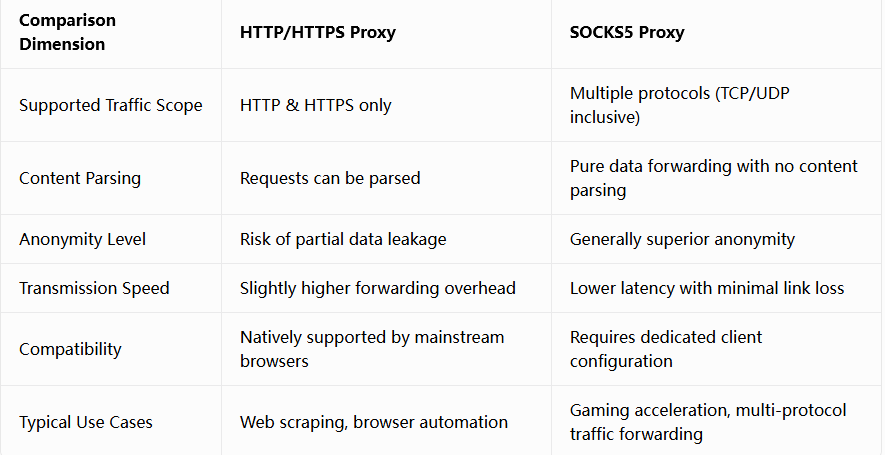
HTTP/HTTPS proxies operate at the application layer, dedicated to web traffic and capable of parsing request content. For HTTPS connections, they establish tunnels to ensure encrypted and secure data transmission.
SOCKS5 proxies function at a lower network layer without examining transmitted content. They forward all types of TCP and UDP traffic, boasting broader applicability for emails, P2P downloads, gaming data and more.
In short: HTTP proxies are optimized for web-based traffic, while SOCKS5 proxies accommodate nearly all forms of network traffic.
Core Differences Comparison
Selection Guide
Choose HTTP/HTTPS Proxy if you need:
Web data scraping, browser automation, API calls, multi-store management for e-commerce platforms, and social media account operation.
Choose SOCKS5 Proxy if you need:
Forward non-HTTP traffic (games, instant messaging apps), enhanced anonymity, simultaneous TCP/UDP transmission, or your client only supports SOCKS5 connectivity.
Common Misconceptions
- SOCKS5 is not inherently superior to HTTP proxy. They serve distinct scenarios with no absolute winner.
- SOCKS5 does not always deliver faster speeds; IP quality and network links are decisive factors.
- Both protocols can be used concurrently, and you may switch between them for different projects as needed.
Conclusion
Your selection should hinge on your business traffic type and anonymity requirements, rather than ranking the two protocols. Prioritize HTTP proxies for web scraping tasks; opt for SOCKS5 for multi-protocol transmission or high-anonymity demands.
9HTTP supports both HTTP/HTTPS and SOCKS5 proxy access. You can flexibly switch protocols for various projects without switching service providers.