
 3 min read


A residential proxy provider should help you complete a defined task at an acceptable cost. An impressive IP count and an inexpensive entry plan are useful starting points for research, but neither proves that the service will work well for your target pages, regions, and operating schedule.
The most reliable purchasing process begins with a short requirement list and ends with a representative trial. Between those steps, compare the conditions that affect everyday operation rather than collecting the largest number of advertised features.
Write down the workload before comparing plans
Specify the destinations, required regions, expected traffic, and number of simultaneous tasks. Identify which requests can use different exits and which must remain connected through one IP. Set an acceptable completion time and cost for the whole workflow.
For example, checking a regional product page once a day needs different resources from monitoring thousands of pages throughout the day. A continuous login-based test also requires different session behavior from independent public-page checks.
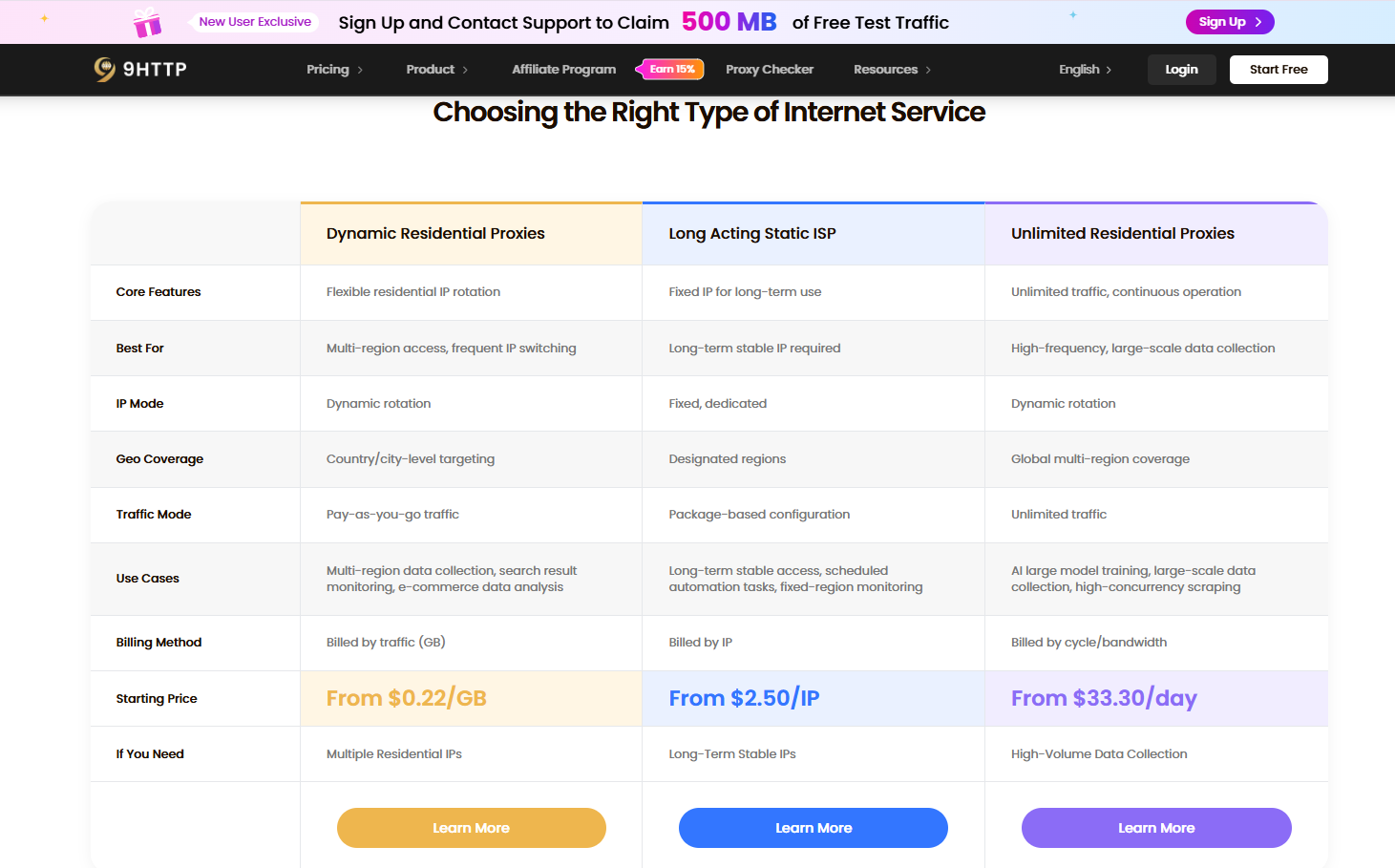
With 9HTTP, this first decision helps narrow the product choice. Dynamic Residential Proxies are the option to evaluate for residential rotation, while Long Acting Static ISP addresses longer-term IP continuity. Define which requirement applies before comparing package sizes, so that a lower entry price does not lead you to the wrong connection model.
Factors to consider when choosing a residential proxy provider
Usable coverage in the locations you need
Total pool size does not tell you how many exits are available in a particular location at a particular time. Test the country or city relevant to your project instead of relying only on the provider's global coverage figure.
Compare an IP location lookup with the destination's actual content. Geographic databases can disagree, and websites may also use account preferences or cookies to determine the region.
Session behavior and failure handling
Confirm whether rotation happens per request, on a timer, or through an explicit session change. For sticky sessions, ask about maximum duration, inactivity limits, and what happens when the residential node disconnects.
The replacement behavior can matter as much as the intended session length. An application should know whether to continue, restart a test, or stop for review after an unexpected exit change.
Billing that matches your workload
Read how data usage is measured, whether traffic from unsuccessful attempts is charged, and when unused allowance expires. Also check minimum purchases, renewal rules, and any capacity limits attached to the plan.
For ongoing workloads, compare a traffic-based budget with 9HTTP Unlimited Residential Proxies. Use the same expected traffic volume and completion deadline for both calculations, then check the selected plan's capacity. Predictable traffic costs are useful only when the allocation can complete the work on time.
Compare cost per valid result, not just price per GB. As a hypothetical example, a $20 test producing 8,000 valid results costs $0.0025 per result. A $15 test producing only 4,000 valid results costs $0.00375 per result. The lower bill is not necessarily the more efficient option.
Sourcing transparency and support
Look for a clear explanation of how residential connections join the network and how participant authorization is handled. Review service terms and permitted use so that your planned workload fits the service.
Evaluate support with a specific configuration question. A useful response should identify relevant settings, explain a limitation, or provide a concrete diagnostic step. Generic assurances are harder to act on when a production workflow fails.
Run a pilot that resembles real use
Select representative pages, including any steps that are slower or more complex than opening a homepage. Keep application settings and request rates consistent across providers. Record content accuracy, completed workflows, response times, traffic consumption, and retries.
Inspect the returned content. An HTTP 200 response can contain a challenge or an incomplete page, so it should not automatically count as success. If the workload runs throughout the day, test during more than one operating period.
Classify failures before drawing conclusions. An authentication error, an unavailable exit, and a target-side restriction need different solutions. Treating them all as proxy failure can lead to the wrong purchase decision.
Turn the results into an acceptance checklist
Separate essential requirements from preferences. A required location, a minimum session duration, and a maximum completion cost can be pass-or-fail conditions. A more convenient dashboard may be a preference rather than a reason to reject an otherwise suitable service. Record each result alongside the test conditions and unresolved questions. If a provider fails an essential condition, request a specific explanation or repeat a targeted test before increasing the purchase. This is more useful than combining unrelated features into a single score that hides a critical weakness.
Turn the pilot into a purchasing decision
When testing a 9HTTP plan, use the same checklist you prepared for the project. Keep the required locations, session behavior, and completion cost visible in the results. If a requirement remains unresolved, bring that specific configuration and test result to support before committing more of the workload.
After the pilot, keep a short record of tested locations, session settings, successful output, and actual cost. This becomes a practical baseline for reviewing the service as your workload grows.
Frequently asked questions
1. How large should a provider's IP pool be?
There is no universal minimum. Available exits in your required regions and the performance of your actual workload matter more than a global headline number.
2. Should I buy the cheapest residential proxy plan?
Only if it meets your quality and capacity requirements. Include retry traffic, unused allowances, and operational effort when comparing total cost.
3. Is a free trial enough to evaluate a provider?
A trial can establish connectivity and reveal obvious problems. Whether it supports a purchasing decision depends on how closely its regions, capacity, and usage conditions match the paid plan you need.
4. Can I use different proxy products in one project?
Yes. Independent regional checks and longer continuous sessions may justify different products. Keep their configurations and usage records distinct so that you can evaluate each workload accurately.